




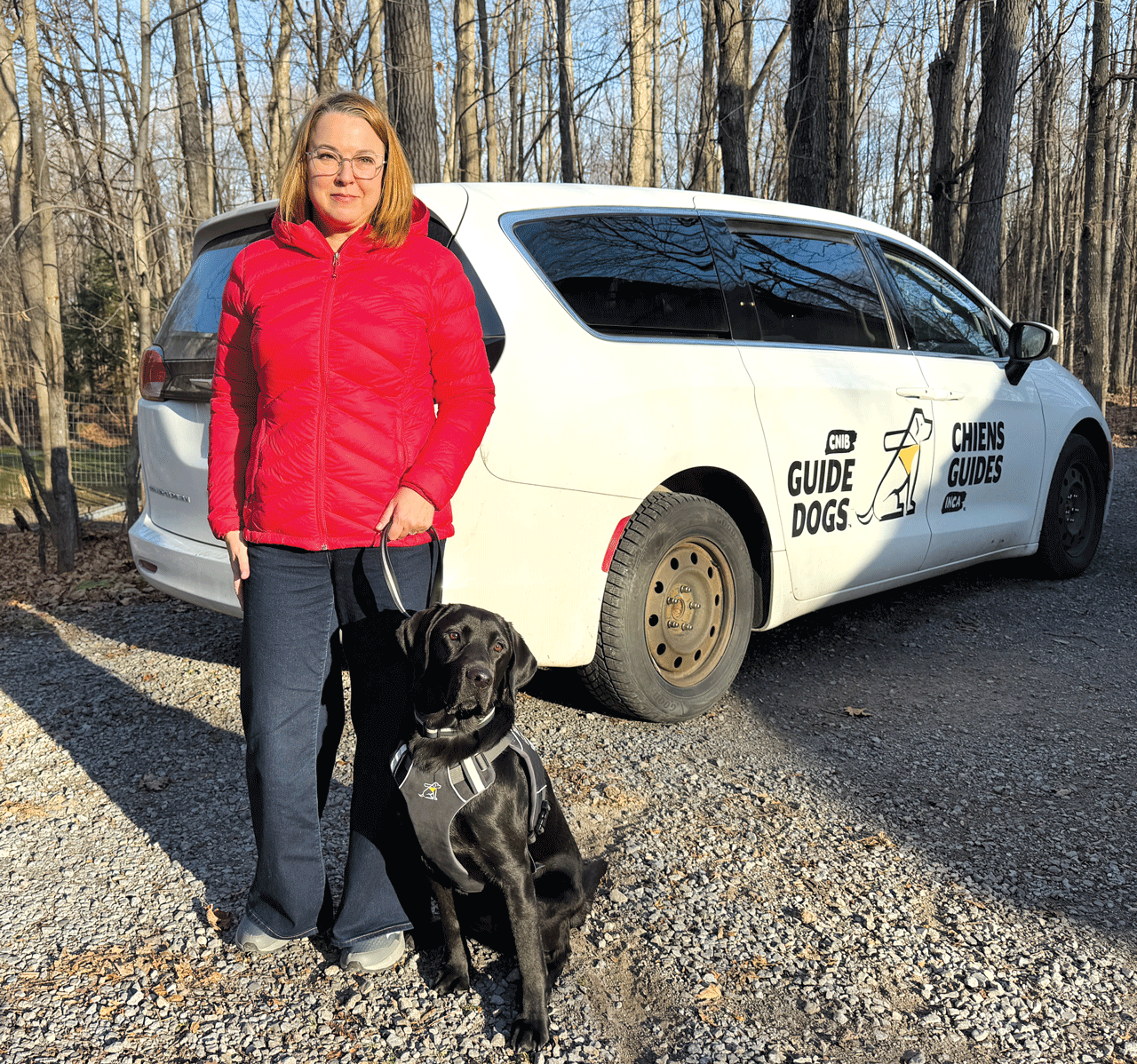

Masham trainer with Institute for the Blind seeks homes for dogs in training
Meet Radar, a guide dog in training. She’s a one-year-old Black Labrador who will happily give kisses when she isn’t working and is set to become a full-time guide dog for people who are blind in the new year. The dogs in training are in need of volunteers to board them while they are in “school”.
Radar is one of the guide dogs being trained by Genevieve Leonard, an instructor at the Canadian National Institute for the Blind (CNIB) and who lives in Masham. The non-profit organization supports people who are blind through a variety of services, and guide dogs are one of them. Leonard works with clients and also trains the dogs.
But to help train a guide dog, having a place for the dog to stay is helpful, and Leonard is looking for volunteers in the Hills to help take care of the dogs in training.
“I require boarders for dogs in training so I don’t have to go to Carleton Place every day,” she said about the drive to the main campus for guide dogs in training; a distance of about one-hour from Masham. Leonard currently trains the dogs from her own home in the Hills, but having homes in the area for dogs that she’s training would reduce her need to drive to Ontario, she explained.
Volunteers preferably need to be from the Chelsea and Masham areas to make pick-up and drop-off easier, according to Leonard. It requires a background check, references and a home inspection to ensure the house is safe for a dog. She said that flexible volunteers are more likely to get approved, so anyone who can be home every three hours or is retired is ideal.
The dogs stay with volunteers for about four to six weeks, depending on the dog and other factors, like holidays.
Leonard said that boarding a dog is similar to having a student; during the week, she picks the dogs up for “school” and drops them back off at a volunteer’s home.
“They’re in school all day and they just stay with you at night and on the weekend,” she explained.
Volunteers are not charged for anything – whether it’s food, vet bills or treats – during a guide dog’s stay.
Once dogs like Radar have completed their initial training, they are matched with a client and then work alongside the client for two to three weeks before becoming full-time guide dogs. Clients wait almost two years on the waitlist for a guide dog.
While having boarders doesn’t speed up the process for those in need of a guide dog, it does mean that they have more confidence, according to Leonard.
“The faster I can train the dog – the more effort and time I can put in the dog – the more confident the dog is, then the more I can match the dog to a client,” explained Leonard.
So far the only volunteer she has had from the Hills is Chelsea resident Amy Pitkethly.
Pitkethly isn’t currently boarding a dog but originally got involved because she said she loves dogs, and it was a way for her to volunteer from home.
She said she found out about the program through Facebook and went through the background check, references and home-inspection process.
She also has her own dog, Roxy, who needed to have all of the required vaccinations before a guide dog could move in – including kennel cough.
About the process of becoming a boarder for dogs in training, Pitkethly said, “It wasn’t that difficult to become a volunteer.” And, about the overall experience, she added it was easy, “You’re just keeping an eye on him.”
In the event that a guide dog in training doesn’t make it through the program, there are other options for the animal such as becoming a therapy dog, according to Leonard. If a dog doesn’t make it through either of the programs, they can be adopted.
Training one guide dog costs the CNIB around $50,000.
More information about the guide dogs, donations and volunteering can be found at: www.cnib.ca/en/programs-and-services/live/cnib-guide-dogs.
