




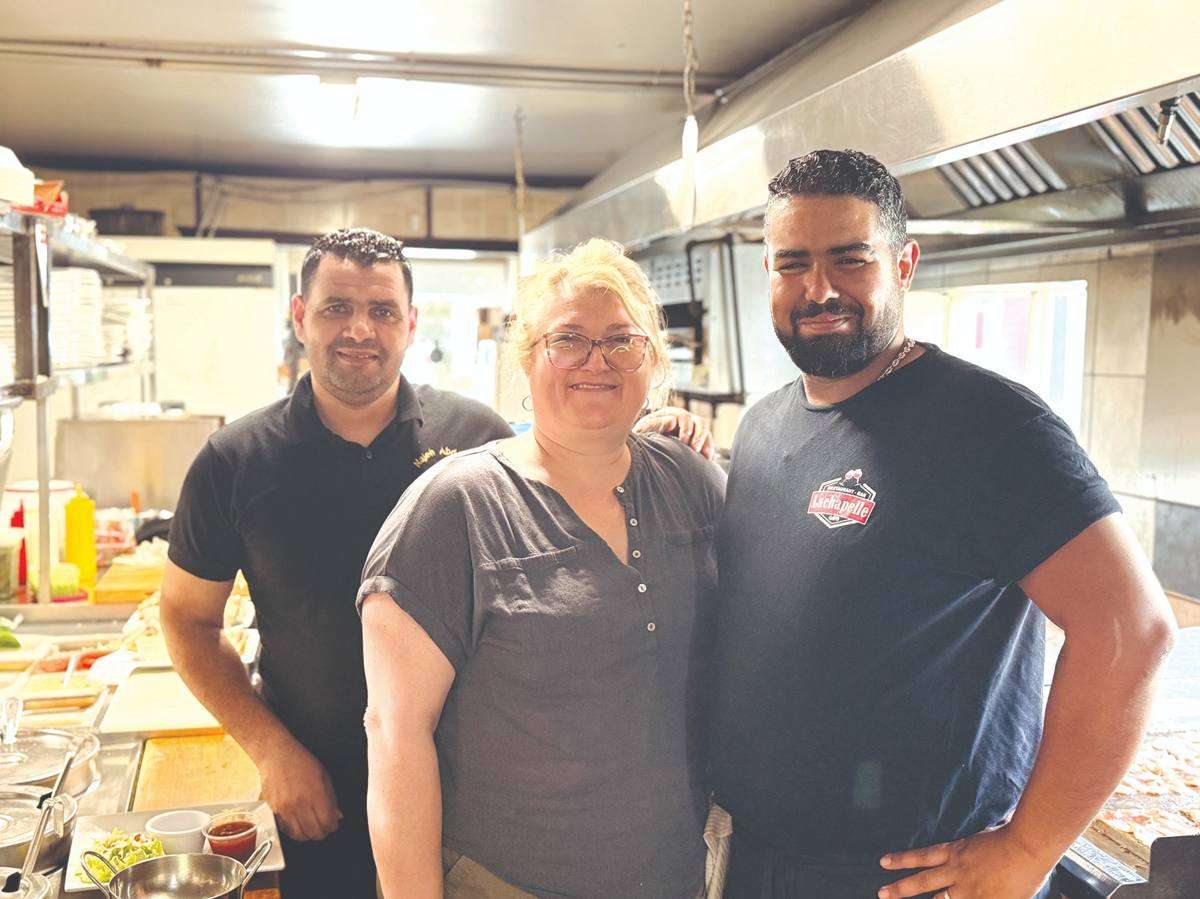

If Kazabazua foreign workers, Najeh Abdelli and his wife are forced to leave Canada after nearly three years, it won’t just mean the end of their jobs – it will uproot a young family that has built a life in the Hills, where their children are learning French, playing soccer and putting down roots.
Abdelli, along with co-worker and fellow Tunisian, Bassem Harrabi, have become well-liked in the community, where they cook up burgers, fries, nachos, wraps, fried chicken and late-night wings at Restaurant Lachapelle, a Kazabazua staple.
Earlier this month, the restaurant’s application to extend both workers under Canada’s foreign workers program was rejected, with restaurant owner Linda Lachapelle being told that she was paying Abdelli and Harrabi too much in wages.
Lachapelle told the Low Down that if her two workers can’t stay, the restaurant will be forced to close every day at 2 p.m.
“I can smile as much as I want in the front, but if I don’t have kitchen workers, I’m not going to do very well,” said Lachapelle, who has been working since she was a teenager at the restaurant for over 40 years. The restaurant has been in the Lachapelle family since 1954.
“All we want to do is just run our business,” added Lachapelle. “We’re not asking for a handout. We just want to keep our employees.”
She said that it is a constant struggle to staff the restaurant, especially since the pandemic. Because the restaurant is so rural, enticing workers from the city, at low wages, is not feasible, she explained. Three years ago they took advantage of Canada’s foreign worker program and hired Abdelli and Harrabi on a three-year contract. And to make it financially work for the workers’ families, the Lachapelle family topped up their wages to $34.61 per hour. But when they applied for an extension, they were told the wages were too high.
“Nobody is going to move up here for $23 an hour,” added Lachapelle. “The cooks all live upstairs; we have apartments on top of our restaurant. They pay their rent … their taxes … their own medical bills. It took 15 months for them to get here, and [when] they finally got here, it was just like a weight off our shoulders because they’re amazing and they do everything.”
Since 2024 the federal government has limited the number of temporary foreign workers in “low-wage” positions in a company to 10 per cent of its workforce. However, Quebec immigration allows employers in rural areas to keep their temporary foreign workers on “low wages” if they were already in service before the announcement of the restriction in 2024, according to Pontiac–Kitigan Zibi MP Sophie Chatel.
She told the Low Down that the Lachapelles applied for the wrong program – a “high wage” program that is often reserved for doctors and engineers. She said the workers now need to re-apply for the “low wage” program, which will see the two workers get paid a maximum of $33 per hour. A decision on that file, however, won’t come for two months.
Chatel said that she’s trying to help Abdelli and Harrabi obtain temporary status, so they can stay in Kazabazua while they await a decision.
“These families have been there for a long time and they are integrated in the community,” Chatel said. “One of the spouses, I believe, is working at a daycare. We want families in our region.”
It’s now a race against time, as Abdelli and Harrabi’s contract expires June 25. The two workers said they worry about the impact it will have on their family if they are forced to move back.
‘Hearts would be broken’
“I love it here, it’s like a family here,” said Harrabi over a steaming grill. “I have a baby, and my daughter’s school is here. If we had to leave, it would be very hard because my daughter [is] learning French. She can speak Arabic, but she can’t read it, and it would be a struggle for her.”
Abdelli said that “three hearts would be broken” if he and his family were forced to leave.
Lachapelle said she and her workers may have found a solution through Quebec’s new Programme de l’expérience québécoise (PEQ), which allows eligible temporary foreign workers already in Quebec to obtain a Certificat de sélection du Québec (CSQ). This is a fast-track pathway to permanent residency for individuals with qualifying skilled work experience and advanced intermediate French-language proficiency. They have applied for the program and are crossing their fingers they will be accepted.
The restaurant owner said she has been “blessed with a wave of love and support by our customers and community,” as well as from Gatineau MNA Robert Bussière and MRC Vallée de la Gatineau Prefect Chantal Lamarche.
Her regional government passed a resolution at its June 16 meeting asking the federal government to “recognize the particular realities of rural areas,” and also “to establish a clearer distinction between large urban centres and rural areas when evaluating economic indicators used to analyze immigration applications.”