





Quebec’s so-called constitution bill “should be relegated to the dustbin of history,” according to the head of Quebec’s most prominent anglophone advocacy group.
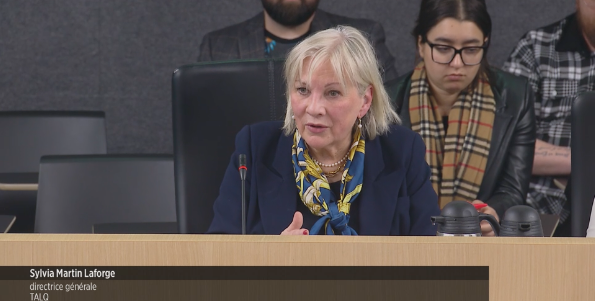
Sylvia Martin-Laforge is the director-general of the organization Talking. Advocating. Living in Quebec (TALQ), an advocacy group that promotes the status of English-speaking Quebecers.
Martin-Laforge recently told the Low Down that TALQ rejects Bill 1, the legislation put forward by the Coalition Avenir Quebec (CAQ) that proposes a Quebec constitution because, among other reasons, it “is not the result of an open and broadly participatory process.”
“This isn’t just concerning for English-speakers. It’s worrying for all kinds of institutions across Quebec,” she added.
Martin-Laforge took TALQ’s complaints all the way to Quebec City on Feb. 17 with a presentation before the National Assembly’s Committee on Institutions which is reviewing the bill.
TALQ was among several groups that testified during the review process, including the Quebec English School Boards Association, the Canadian Civil Liberties Association, the Task Force on Linguistic Policy, the Coalition of Civil Society Organizations, and the Quebec Bar Association.
In her statements to the committee, Martin-Laforge addressed the specific aspects of the bill that concern TALQ as advocates for English-speaking Quebecers.
“Concerning minorities, let me speak of our own. Bill 1 makes no mention of Quebec’s English-speaking community’s citizens – only a brief, tangential reference to its “institutions” in the preamble – before going on to undermine some of the very institutions it promises to protect or value,” she said.
Martin-Larforge pointed to The Autonomy Act within the proposed constitution that she said “would forbid school boards, universities, municipalities, professional orders, hospitals and more than 120 organizations from challenging government laws in court using public funds, as they now are able to do.”
She added that The Autonomy Act “is a deterrent measure intended to discourage public bodies – some of which are key institutions of Quebec’s English-speaking community – from defending the rights of Quebecers in court.”
According to Martin-Laforge in her statement, “The bill would also permit the government to issue wide-ranging ‘directives’ against independent bodies in response to any federal initiative the provincial government decides would cause ‘prejudice’ to Quebec. Important institutions linked to the English-speaking community of Quebec would be caught in this net, too.”
In her comments to the Low Down, Martin-Larforge expressed concern that the constitution would threaten a vital lifeline of support for the English-speaking community via the federal government.
According to her, Bill 1 “attempts to cut our links with the federal government for funding, which for the English-speaking community is a concern…. If the [CAQ] wants money [from the feds] to flow through the province, we’re concerned about how that money would [reach] the English-speaking community, because the provincial government does not recognize us as a legitimate minority.”
While TALQ’s primary concern is the impact of legislation on the English-speaking community, Martin-Laforge said her organization “considers the common ground we have with the majority francophones, with a view to social cohesion. The English-speaking community does not operate in a bubble…. We all go to hospitals, we all have long wait times, we all want to be represented culturally.”
She added that TALQ is not opposed to a Quebec constitution on principle, but asserted, “This one needs to be thrown out entirely and they need to start over.”
Bill 1 has received widespread criticism since it was introduced last fall. Legal experts and civil rights advocates have expressed concern that the proposed constitution emphasizes collective rights over individual rights and limits publicly funded organizations from posing legal challenges to certain laws.
In November, a group of 28 academics, including professors of law and political science, wrote an open letter in Le Devoir condemning the legislation as “a serious setback for democracy.” In January, Amnesty International called for the full withdrawal of Bill 1, calling it “regressive and anti-rights, with several of its articles jeopardizing the rights of linguistic and cultural minorities as well as those of Indigenous Peoples in Quebec.” The statement from Amnesty International also asserted that the bill “lacks any legitimacy as no public consultation of any kind was conducted.”
RAWQ also takes the stand
The Regional Association of West Quebecers (RAWQ), an Aylmer-based non-profit and member of TALQ, also presented to the Committee on Institutions at the National Assembly. On Feb. 5, executive director Alina Seguin-Holmes and associate president Chad Bean addressed the bill’s potential impact on all stakeholders, with a specific focus on English-speakers in West Quebec.
In an interview with the Low Down in December, Bean said that RAWQ believes that “education and healthcare services in West Quebec are already strained. He added that “by centralizing power in Quebec City and making unilateral decisions without proper consultation,” the bill further neglects the needs of the region.
“This top-down government approach overlooks the realities here in a rural region … it could limit our options and amplify our isolation,” he cautioned.
“[Bill 1] is framed around collective rights. We believe it ultimately erodes democratic accountability. It also offers no accessible amendment process and prioritizes the Quebec nation over serving its people,” Bean said.
Following presentations to the committee, Bill 1 will soon undergo a clause-by-clause review in the National Assembly. It does not appear to have the support of the three opposition parties – the Quebec Liberal Party, Parti Québécois, and Québec Solidaire all voted against its tabling back in October.
The CAQ holds a majority of seats in the National Assembly. In October, Bill 1 was successfully tabled after receiving 71 votes, all from CAQ members including Gatineau MNA Robert Bussière.
Although the CAQ is preoccupied with a race to replace François Legault, who announced his resignation as premier in January, according to the journalist Stephen Thompson writing for The Walrus, “The immediate political risk to Bill 1 is limited. The bill is carried by the justice minister, Simon Jolin-Barrette, a leading contender to succeed Legault, and with no election expected before October, the legislation has a clear procedural path to adoption within the current National Assembly.”