




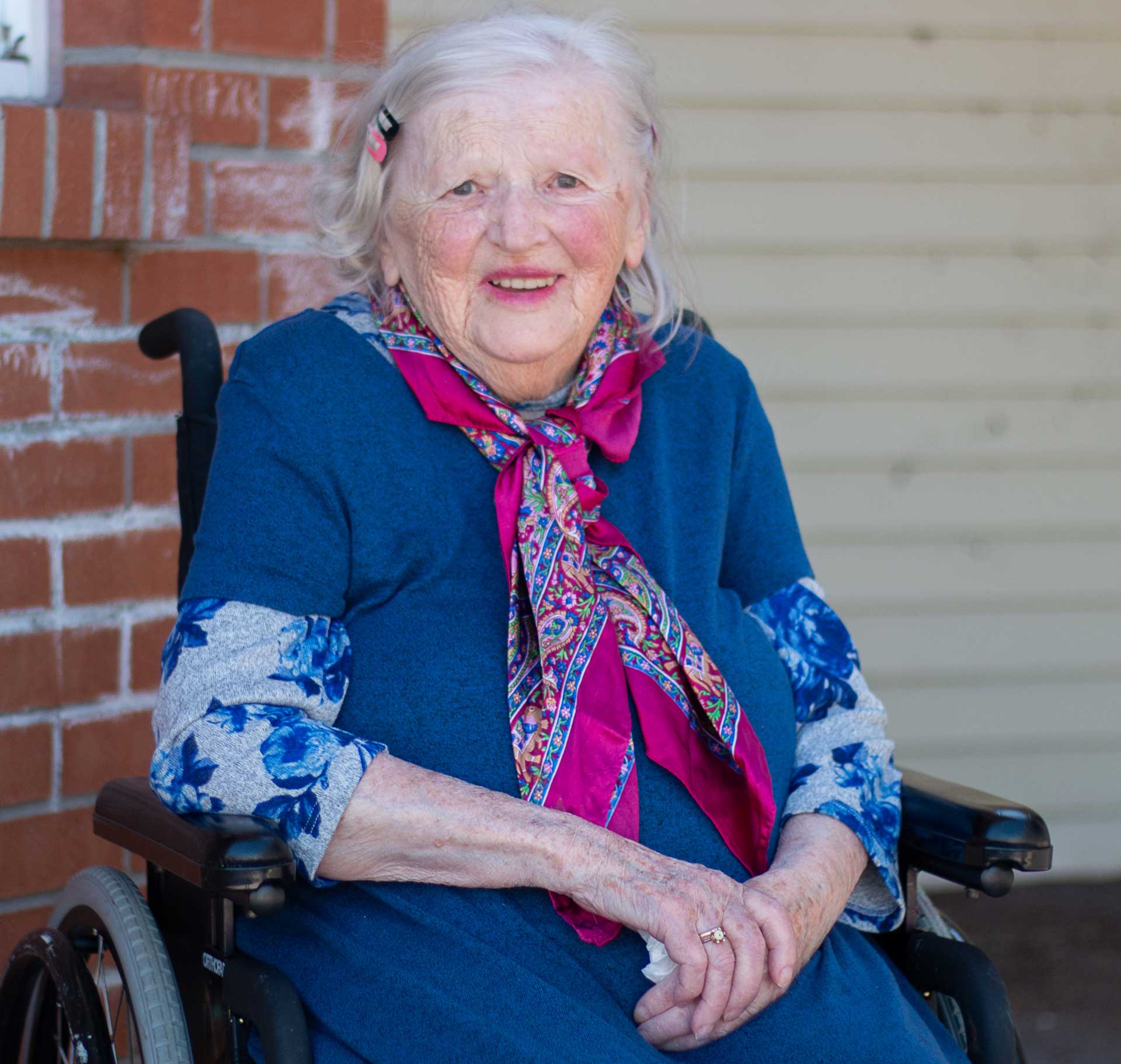

Chelsea’s Wanda Rowicka remembers hiding food in her book bag in wartime Poland to help Jewish families. She was captured during the war and taken to Germany before allied forces liberated her and she journeyed to Belgium, England and Canada.
In April, Rowicka celebrated her 100th birthday in the Gatineau Hills.
It was a busy party celebrating a century for the longtime Chelsea resident. With her kids, four grandkids and ten great-grandchildren all by her side, Rowicka celebrated her 100th birthday on April 18. “It was good,” Rowicka said about the party at the long-term care residence in Masham. “Noisy and lots of food!” Nothing makes Rowicka happier than a great meal with her family and friends.
Rowicka was born in Warsaw, Poland in 1925. She said she was a good kid, quiet and good in school. “Everybody praised me,” she laughed.
As a teenager, her home town was occupied by the Germans after the Nazi invasion of Poland in 1939. Rowicka and her family were part of the Polish resistance and helped Jewish families as they fled Nazi forces.
Rowicka’s mother sewed a hidden compartment into her book bag. “I was handling meat for the refugees,” she said. She used the bag to smuggle food to Jewish refugees and messages for the resistance in direct contravention of the Nazis.
Rowicka said she was regularly stopped by the Nazis for searches as was common on the streets of occupied Warsaw, “but they never caught me,” Rowicka said with a wry smile. She kept the hidden goods under her school books in the secret compartment of the bag.
Later in the war, when Rowicka was nearly 20, she was seized by German soldiers to contribute to the war effort. “I wasn’t actually arrested,” she said. Near the end of the war, it was common for German soldiers to indiscriminately take civilians to work in camps as the Germans were desperate for labour. Rowicka was snatched on her way home from school and was transported to Germany via train and put to work. “They made me dig potatoes,” she said. And after working on a farm, she was moved to a factory assembling wheels for German airplanes.
At the end of the war, the German soldiers running the work camp fled and the prisoners were left alone for a few days before the Americans liberated the work camp. But Rowicka was unable to return home. She and her fellow workers raided the kitchens and storehouses. “We ate chocolate biscuits,” Rowicka said. The prisoners hadn’t seen chocolate or alcohol in years and gorged themselves with their new found freedom.
The Soviet army liberated Warsaw from Nazi control but established its own regime in Poland. Rowicka was displaced and had no papers documenting who she was, as she had been seized from Poland. She resided in a Red Cross camp in Belgium, unsure of where she would go next.
There were millions of refugees and displaced people in Europe with food and information hard to come by.
While at the camp, Rowicka said she didn’t know where her family was or if they had survived the war. And she said they only had one thing to eat. “I had pumpkin everyday,” she said, and swore to never eat it again.
While in a camp, she interacted with a British soldier who knew Rowicka’s brother, Kazimierz, who had served in the British Royal Air Force as a decorated pilot during the war. “My brother went to England and joined the air force,” she said. “And he became famous.” His plane was shot down midway through the war in Belgium. Kazimierz sought shelter in a barn, and a local widow took him in and helped him return to England. Through Kazimierz’s friend at the refugee camp, Rowicka contacted the Belgian woman who took her in and hired her as a translator because she spoke Polish, German and was learning French.
Rowicka was able to immigrate to England in the late 1940s and reunite with her brother. In London, she met the man who would become her husband, Stefan Bandrowski. The couple met at a Polish dance in London and after marrying, the couple immigrated to Canada in 1955. She remembers sailing into Quebec City and falling in love with Canada as soon as she saw the view.
The couple lived in Montreal and Ottawa before moving to Chelsea in 1975. Rowicka said when she arrived in Canada, she was astonished by the amount of food. “We could buy anything,” she said. While Canadians faced rations during the war, it wasn’t as severe as the rations faced in England until 1954 – almost a decade after the war ended, also to mention the scarcity of food in Poland during the war.
Rowicka has lived in the Hills for 50 years. “We had a house, and a place to live,” for which she said she is grateful. The family lived in the Tulip Valley area close to where Motel Chelsea now stands. “I loved the woods,” she said, remembering the house her husband built. “It was built in Chelsea.” Rowicka raised her four children and then after they moved out, she worked in Ottawa as a home maker in Little Italy. Everyday she would take the bus along Hwy 105 into the city.
While telling her life story, Rowicka’s lunch was brought outside on a tray to the table where she was sitting. “There is soup!” she exclaimed. At age 100, Rowicka is currently enjoying the beautiful springtime sunshine and enjoys opportunities to eat a good meal outside on the patio at the care home in Masham with her friends.
Rowicka said the key to life is patience, optimism and hard work. “Try not to make any trouble,” she said. And when she was in captivity, she never lost her optimistic outlook. “I always said, see what tomorrow brings.”
And the thing that makes her happiest is a great meal. She is happy to have chefs at the care home who sometimes can make her some Polish specialties. “The people who cook are Polish,” she said. And her daughter sometimes brings her Polish treats from the Eastern European deli in Ottawa like pickled fish, borscht, Polish sausage and sesame candy.