




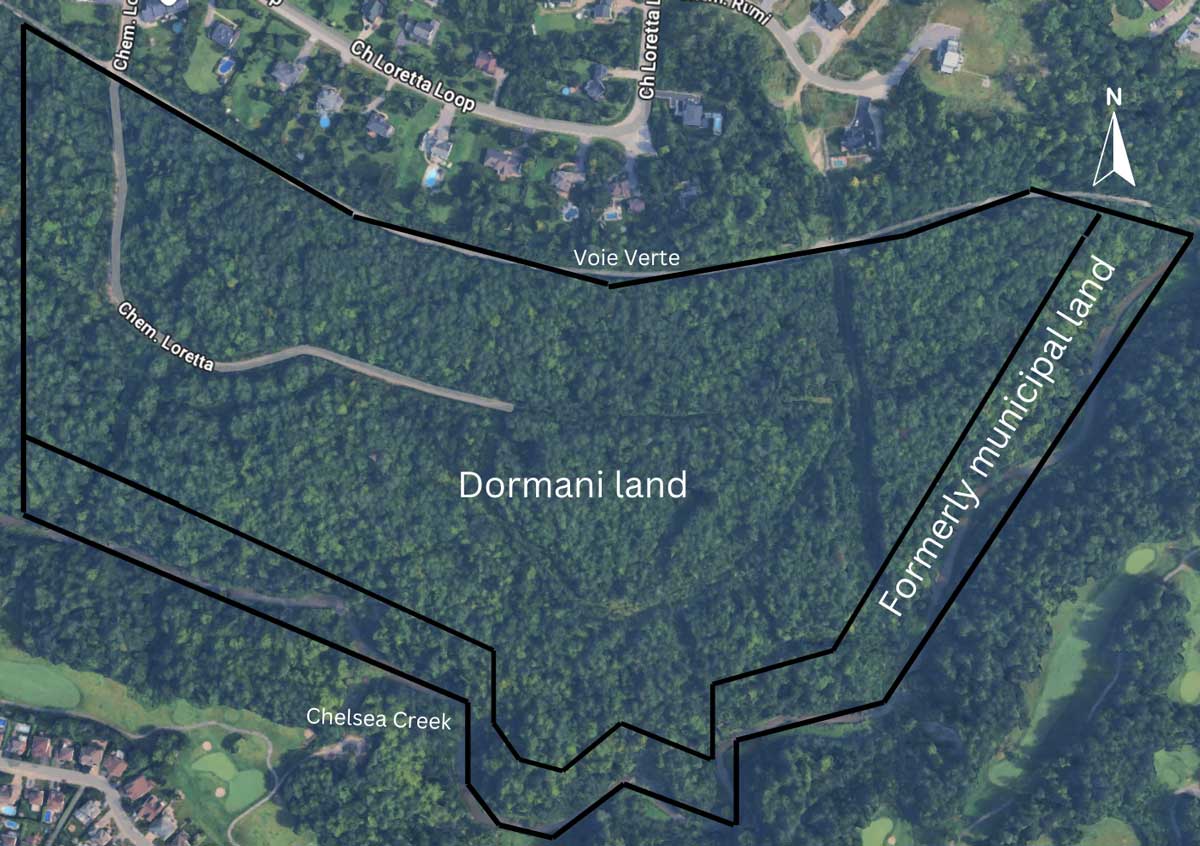

Chelsea municipality and local businessman Mansour Dormani have agreed to a land swap as part of an out-of-court settlement after Dormani’s company sued the municipality. Chelsea will give Dormani land along the shore of Chelsea Creek in exchange for land next to the Voie Verte to be used for a new park.
Few details of the lawsuit are publically available but according to councillors, Dormani, the owner of a large piece of land in the south end of the municipality, sued Chelsea through his company over a neighbouring plot of land. Dormani’s land is about 62 acres of forest between the Voie Verte and Chelsea Creek, north of the Hautes Plaines golf course. Along the bottom of Dormani’s property is a thin but long stretch of municipal land which separates the Dormani lot from the creek. The land is in a landslide zone due to the instability of the municipal land.
In order to build on his land, Dormani would need the municipality’s creek shoreline land stabilized.
This, according to councillors Rita Jain and Dominic Labrie, was the primary question of the lawsuit. “The developer demanded that we stabilize the municipal land so that he could develop his,” Labrie said.
The result of the legal action is an out-of-court legal settlement as opposed to a full lawsuit. Chelsea Mayor Pierre Guénard said at a Jan. 31 council meeting that fighting the suit could have been expensive. “It’s an out-of-court settlement not to go in court and have a potential multi-million dollar judgment,” said Guénard at the meeting.
Both Jain and Labrie believe the municipality could have won the lawsuit.
“There is no reason why a municipality should have to contravene its own bylaws regarding shoreline protection and ecological corridors on its own property to enable private development on neighbouring properties,” Jain told the Low Down. Labrie agreed and said the land is naturally unstable and Chelsea shouldn’t have any requirement to stabilize it.
But just because Chelsea agreed to give the land along the creek to Dormani doesn’t mean he can develop the land. Municipal bylaws place restrictions on new development next to waterways.
Chelsea resident and lawyer Gordon Hill, present at the Jan. 31 meeting, asked if Chelsea would enforce its bylaws on development setbacks and asked if Chelsea had communicated that to the land owner in the settlement. The municipality said it couldn’t directly answer what was included in the settlement.
However, councillors Kimberly Chan and Christopher Blais said Chelsea would stand by its regulations. “I fully expect the municipality to continue enforcing its bylaws and continue improving its bylaws and being an environmental leader in Quebec,” Blais said at the meeting.
According to a municipal release on Feb. 13, Dormani plans to build 40 homes on the property. He will stabilize the land along the creek at his own expense and will have to follow many environmental regulations as outlined in Chelsea bylaws.
ACRE says creek land is ecological corridor
ACRE President Stephen Woodley, also at the meeting, said the land Chelsea has relinquished is of substantial importance. “It’s a designated ecological corridor,” Woodley told council. He noted that corridor bylaws should prevent development within a certain setback from the creek. “[That corridor] has the highest density and highest diversity of wildlife,” Woodley said. He said the property previously owned by the municipality along the creek shore is a “fundamental part” of conserving the Chelsea Creek corridor.
The municipality said in February that the developer will need to meet provisions for protecting the Chelsea Creek habitat connectivity corridor.
With the creek shore now in the hands of Dormani, the municipality will, in return, get a section of Dormani’s original plot of land: about five acres of the total 62. Chelsea said it can build a needed park on the five acres of land.