





Services at regional hospitals, including Maniwaki, Pontiac and Wakefield, could be drastically cut this summer, according to a worst-case scenario contingency plan developed by the Outaouais healthcare service, Centre intégré de santé et des services sociaux de l’Outaouais (CISSSO).
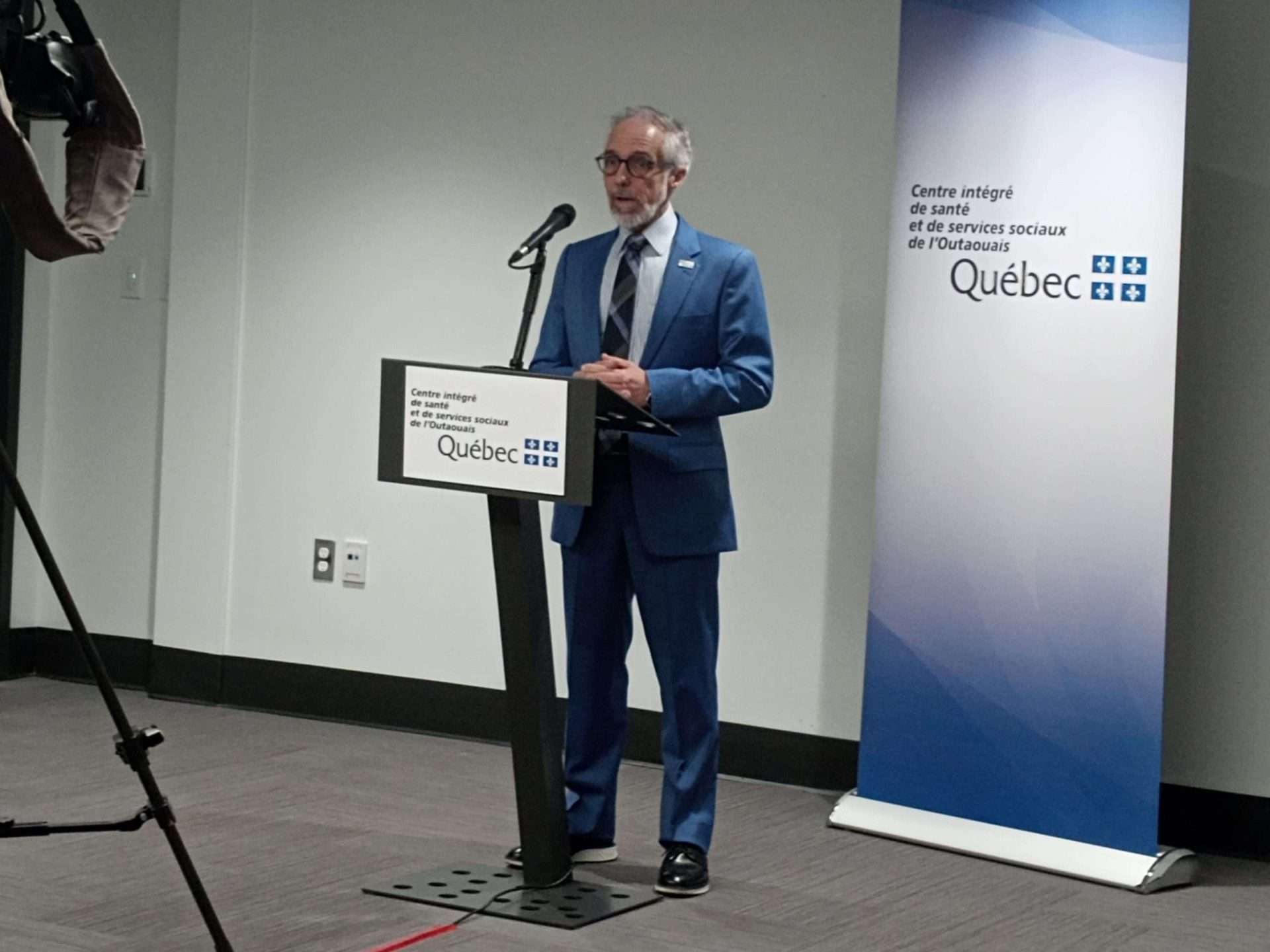
At a press conference held in Gatineau on May 22, Dr. Marc Bilodeau, CEO of CISSSO, said that healthcare workers are entitled to take time off in the summer. However, with staffing shortages already at unprecedented levels, this could mean closing imaging and surgery at regional hospitals to centralize personnel at the Hull Hospital.
The contingency plan, first broken by Le Droit on May 22, covers a period from June 17 to Sept. 8 and outlines stages and conditions for dealing with shortages in operating rooms and medical imaging sectors.
Over this time period, it’s possible that the Gatineau Hospital could become a centre offering only limited emergency services, as well as mental health and long-term care beds. The operating rooms of the Gatineau, Papineau, Pontiac and Maniwaki hospitals could close.
While Wakefield Hospital doesn’t perform surgeries, nurses and other personnel could be moved to the Hull Hospital to cover shortages where necessary.
“Obviously, Wakefield is part of our pool of people, nurses and technicians that we can solicit to come, on a voluntary basis, if possible,” Bilodeau said at the press conference. “We need to take into consideration that there are people available there, while [acknowledging] there will be an impact if we leave the Wakefield hospital uncovered for long days or shifts. We need to manage that impact and make sure there is an appropriate level of access to care for people in the MRC des Collines.”
Bilodeau said that obstetrics would remain open at Gatineau Hospital through the summer with a plan to make two operating rooms available – one exclusively for individuals in need of an emergency or planned c-section.
However, Le Droit has reported that, based on CISSSO’s own plan, there is a scenario where childbirth services for the entire region could be relocated to Hull Hospital.
Previously, Gatineau’s Dr. Peter Bonneville told the Low Down there would only be one operating room open at the Gatineau Hospital over the summer, which he said could jeopardize the safety of anyone requiring an emergency cesarean.
The shortages will impact cancer patients too. In the worst-case scenario, only 60 per cent of oncology cases could be operated on within the maximum target of 56 days. In the final stage of CISSSO’s surgical contingency plan, only the Hull Hospital OR would remain to serve a population of around 400,000. Operating rooms at Maniwaki, Pontiac, Gatineau and Papineau would be entirely closed, and the Gatineau Hospital could be forced to offer only ambulance services.
At this stage, CISSSO said it expects that there could be a “risk of avoidable deaths” due to delays in diagnosis and treatment, according to Le Droit.
The heightened demand on staff could result in widespread burnout, including among anesthesiologists, Bilodeau admitted.
More deaths ‘inevitable’
Marcel Chartrand, a spokesperson for Vigi Santé, a healthcare watchdog, told the Low Down that burnout among staff is already occurring and could get far worse if shortages over the summer are as severe as predicted.
He also said that deaths that might have otherwise been avoided are now “inevitable.”
“There will be people who will be lost in the cracks because of the shortage of services. It’s that simple,” Chartrand asserted. “If you borrow resources from Wakefield, for example, or from Maniwaki, or from Buckingham to serve one hospital, the demand will still be there. The demand in the summer is quite large, actually. So now, some people will…probably lose their lives.”
Wait times have been stretching on for years now, Chartrand said. The wait time for a mammogram, for example, is already five to eight months, he pointed out, and patients requiring an MRI usually wait more than a year in the Outaouais. All of that could get much worse given CISSSO’s projections for the summer.
Current wait times at the Wakefield hospital are five hours and 55 minutes.
Chartrand said the ongoing healthcare crisis is the direct result of years of underfunding.
“It’s a failure of politicians to recognize that the region has as many needs as Montreal or Gaspésie or Témiscamingue, and it’s not being acknowledged…. And when they do throw money at it, it’s so small that it’s basically negative.
“The whole issue in my estimation is chronic, chronic underfunding. And we’re talking about hundreds of millions of dollars every year. Recognized by the government, recognized by politicians, but they’re doing nothing about it,” Chartrand said.
A recent report from The Outaouais Development Observatory, an organization dedicated to researching and collecting data regarding the region’s economic development, revealed that the region needs $180 million in healthcare funding to be on par with other regions in Quebec.
Chartrand gave the example, recently reported in the Low Down, of three medical technicians who left the Gatineau region to work in Ontario where salaries are higher. The province offered a bonus of $20,000, but it was not enough to entice the technicians to stay.
The situation is exacerbated by the fact that many doctors and nurses prefer to work for private agencies, which costs hospitals like Wakefield’s far more money to contract these professionals.
According to data from the Ministry of Health, the use of for-profit nursing agencies costs the Quebec public system $960 million in 2022, an increase of 380 per cent compared with 2016.
Chartrand advises residents to be proactive about their own healthcare and consider seeking services in other regions, such as Montreal, if possible.
“Individuals have to plan for their worst-case scenarios, too,” he said.
Gatineau MNA Robert Bussière was not available for an interview but said in a statement to the Low Down, “Our government is aware of this worrying situation in the Outaouais…Currently, we are looking at short-and-medium term solutions that will allow us to intervene effectively in the region… I assure you that we are monitoring the situation very closely to keep operating theatres open and provide healthcare to the population.”